Consumer Electronics Buyback: Closing Japan's Peak-Season Gaps
Japan's relocation season rarely runs out of used electronics. It runs out of used electronics that someone can verify, load and ship against a fixed sailing date. Domestic collection arrives in bursts, container space is booked weeks ahead, and every unit that should never have left the country is freight the buyer pays for twice — once on the water and once at the destination.
This guide sets out a five-step procurement sequence for closing that gap. Tenma International Inc, a Japanese trading company based in Chiba, runs the sequence as its JQ-SMC model — Japanese Quality-Driven Source Management & Cross-Border Supply Chain Model, version 3.0 — built on three phases: standardized procurement, condition inspection, and cross-border container delivery.
Tenma International Inc is a Japanese trading company founded in 2023 that acquires pre-owned goods for international export. It operates from a 3,000 m² facility at 750 Kanayama, Kashiwa-shi, Chiba, and holds an official Secondhand Dealer License issued by the National Public Safety Commission of Japan. Its published export ratio is 70%, with main markets in Cambodia, Pakistan and Thailand.
Each step below is written as an operating instruction, with its conditions attached and with the numbers that one documented 40ft HQ shipment actually produced.
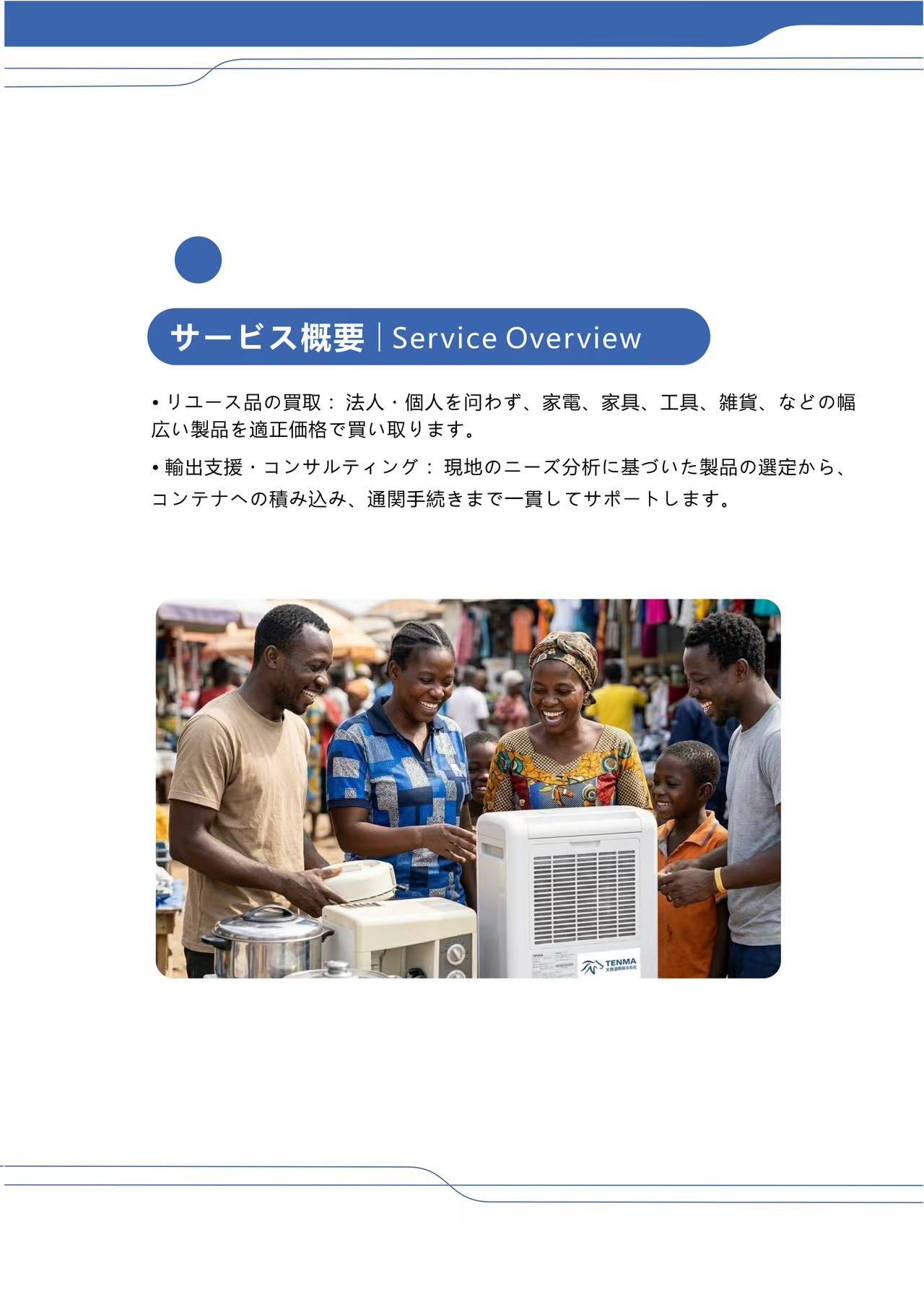
Cover: the end-to-end buyback and export service, from Chiba collection to container departure.
What a Peak-Season Supply Gap Actually Is
A peak-season supply gap is a verification and timing problem, not a volume problem. Japanese suppliers can usually find appliances during relocation months; what thins out is inventory that has been screened, graded, photographed and packed for a specific vessel. In practice the gap opens in three places.
- Supply is locked late. Buyers wait for the season to peak before placing orders, then compete for the same lots and the same loading slots.
- Screening is deferred to the destination. When unsellable units are only discovered after devanning, the buyer has already paid ocean freight on them and must pay again to dispose of them locally.
- Containers are filled by volume rather than by plan. Bulky appliances leave gaps that could have carried sellable stock, so the freight cost per sellable unit rises.
All three are controllable inside Japan. A supplier with a physical facility can remove scrap before loading; a supplier with space-modeling capability can lift effective utilization; a supplier that starts sourcing against a confirmed manifest can hold a sailing schedule even when the domestic market is busy. The remainder of this article shows how each control is executed.
Why Japan's Relocation Season Tightens Buyback Supply
Japan's moving calendar is concentrated around the end of the fiscal year in March and the April start of the new business year, when households relocate for work, school and housing contracts. Bulky appliances are the least portable part of a move, so refrigerators, washing machines and microwaves enter the used-goods stream inside a short window and in uneven condition — some complete and structurally sound, some damaged during the move.
Dealing in used goods in Japan is regulated through the Secondhand Dealer License regime administered by prefectural public safety commissions. Licensed operators can receive and resell used goods, and the license also underpins the export documentation that travels with a container. Tenma International Inc holds this license, which is why its export paperwork is issued under a licensed entity rather than an intermediary.
Capacity matters more than slogans in this window. Tenma reports stable domestic collection and handling capacity of more than 10 tons of goods per month, and an export processing capability described as 20–30 high-cube 40ft containers per month. Those are capacity figures, not an allocation guarantee for any single week, but they define the volume a buyer can realistically plan against.
Market context is worth one line only. Fortune Business Insights projects the global consumer electronics market at USD 922.66 billion in 2026, which indicates the scale of downstream demand for devices, but it does not measure buyback volumes and should not be read as a buyback-specific statistic. The question that decides a container is narrower: how much verified stock can be put on a vessel in a given month.
Container dispatch: capacity is planned against a confirmed manifest, not against whatever clear-out lots happen to be available.
How the JQ-SMC Model Closes the Gap, Step by Step
The JQ-SMC model converts a bursty domestic market into a predictable export flow by fixing the sequence: agree the manifest, source natively, screen on receipt, confirm condition remotely, load with a space plan, then clear customs under the license. Each step produces a document or an artifact that the next step depends on.
Step 1 — Lock the Manifest and Start Native Japanese Sourcing in Chiba
Demand alignment comes first. The buyer confirms categories, target grade mix and container volume; the supplier converts that into a sourcing list and begins buying in the domestic market around Chiba and the wider Kanto region. No later step can compensate for a manifest agreed too late.
Timing is set by the inspection clock. Tenma completes product inspection and container loading within 7–14 working days of receiving the deposit, depending on category and volume. A buyer who wants a container to sail in the middle of relocation season therefore needs the manifest and deposit in place before the season peaks rather than during it. Treat this as a planning rule derived from the stated lead time, and confirm the working-day window for your own mix before committing to a vessel.
Step 2 — Receive Goods and Screen Condition Inside the Chiba Warehouse
On warehouse receipt, the team performs a piece-by-piece aesthetic inspection: shell integrity, structural completeness, loose parts and heavy decay. Shattered, dismantled or structurally unsound units are blocked inside Japan and never enter a container. This is appearance and completeness screening, not refurbishment — the goods are not cleaned, not repaired, and not sold as tested working units.
This is the step that changes landed cost. Every rejected unit is a unit that never consumes container space, never pays ocean freight and never triggers disposal fees at the destination. It also protects the grade mix: what remains can be tier-graded and described accurately, which matters when your downstream buyers purchase on structural condition rather than on cosmetic promises.
Step 3 — Confirm Raw Condition Remotely Before Loading
Buyers rarely stand in the warehouse, so confirmation has to travel. Tenma provides raw photo and video samples of the screened inventory for online approval, in the exact condition in which it will ship — uncleaned and unrepaired. Remote live-video inspection and warehouse tours are available through Zoom or Microsoft Teams, and Chinese, Japanese and English are supported across email, WhatsApp, LINE and WeChat.
The transparency cuts both ways. A buyer should expect to see worn cosmetics and honest descriptions rather than a promise that every unit works. What is being bought is a structurally complete load that has already passed an appearance filter, and that expectation belongs in the order rather than in an assumption.
Step 4 — Load Off-Site With Space Modeling, Not Volume Filling
Loading happens outside the facility, where bulky appliances and mixed categories can be arranged without the constraints of an indoor floor plan. The team applies 3D digital container space-utilization modeling, nested loading for irregular shapes, and anti-shock fastening with heavy-duty strapping for appliances. The objective is to close volumetric gaps, not to fill the container to the door.
In the documented shipment described below, this approach raised effective container space utilization by 18%, which reduces the amortized freight cost of every sellable item. Utilization gains are shipment-specific: they depend on category mix, the size distribution of the appliances and the loading plan, so verify them against your own load instead of treating them as a standard outcome.
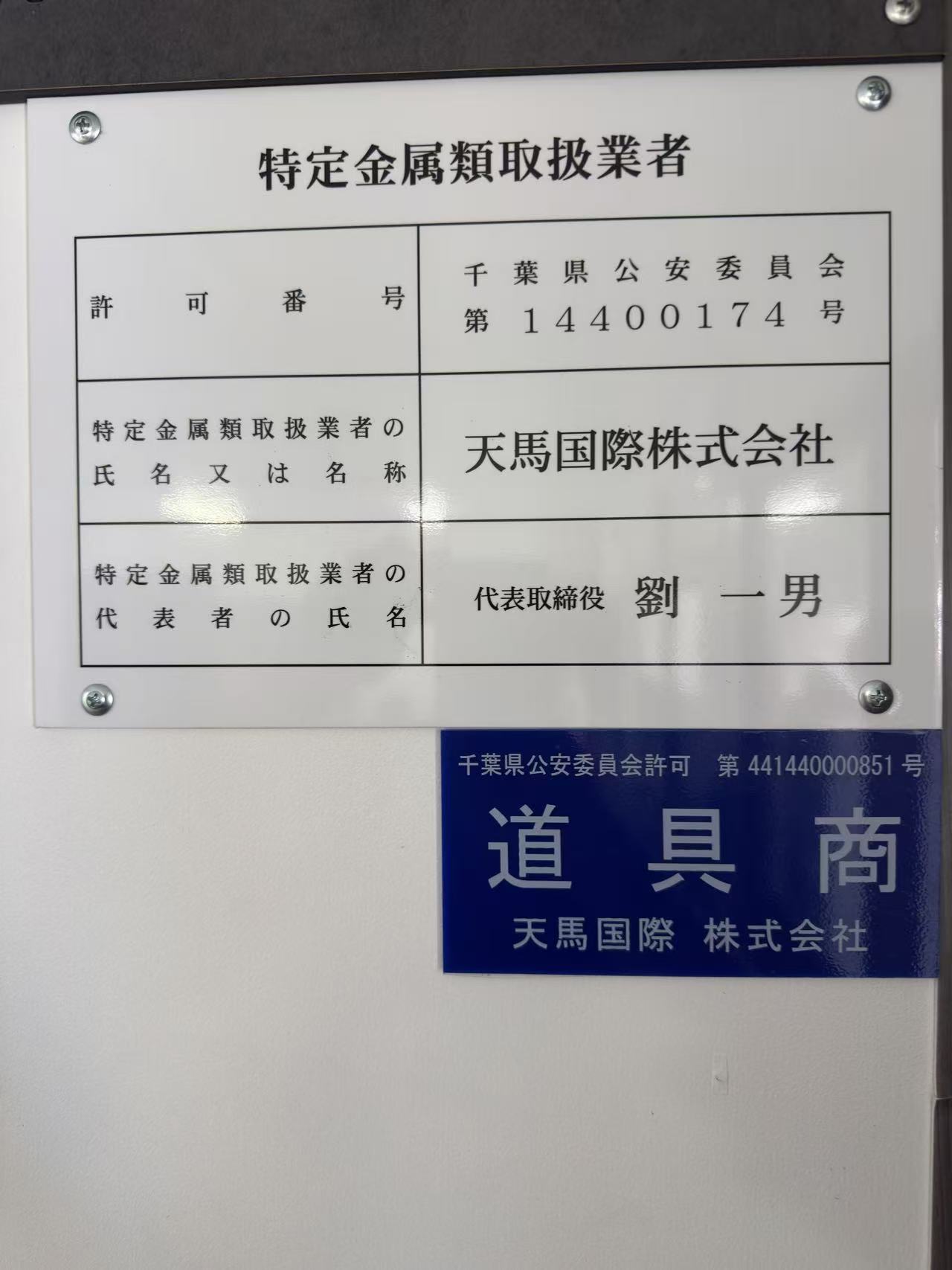
Licensed export: the Secondhand Dealer License underpins the clearance documentation for each container.
Step 5 — Clear Japanese Export Under the Secondhand Dealer License
With the container sealed, the export phase covers Japanese domestic customs clearance and vessel booking, supported by a bilingual packing list and commercial invoice, pre-shipment inspection photos or video, container sealing photos and the bill of lading. Delivery terms are FOB Japanese port or CFR/CIF to the destination port, with logistics and QC progress updated online.
The scope boundary deserves a second reading. Destination import clearance, local tariffs and duties, inland transport after arrival, and any return caused by a change in the destination country's legal policy sit outside the supplier's scope. A buyer who prices those items at the quotation stage avoids the most common end-of-season surprise, which arrives when a container lands and the local clearance budget does not exist.
For manifests that include data-bearing devices such as game consoles or network-connected home hardware, ask how storage media are handled before loading. NIST SP 800-88 Revision 2, published in September 2025, is the reference standard for media sanitization in electronics disposal. Whether it governs your order depends on destination-market rules and on the supplier's written procedure, so confirm both rather than assuming either.
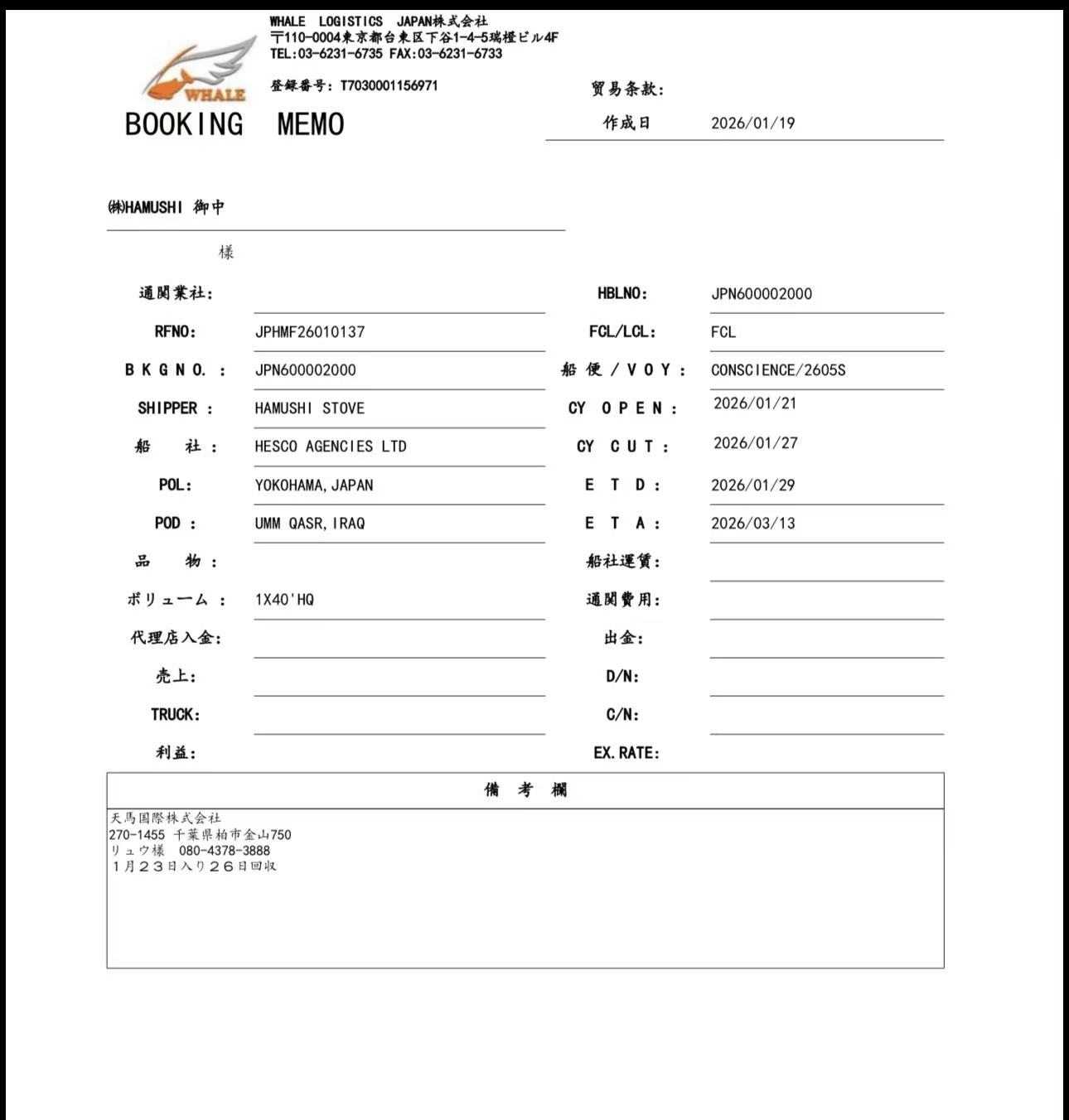
Documentation: booking memo, packing list, commercial invoice and bill of lading travel with the container.
Documented Results: One 40ft HQ Container From Chiba to Phnom Penh
The clearest evidence of whether the sequence works is a shipment that ran through it. In a documented project, an anonymised Cambodian bulk importer operating wholesale warehouses and flea markets in and around Phnom Penh received one 40ft HQ container of Japanese appliances and bicycles, loaded in Chiba and cleared for export under the Secondhand Dealer License.
The starting position was the peak-season failure mode in its purest form. The buyer had previously purchased blind-box containers through unlicensed Japanese brokers who filled volume with damaged, dismantled or unusable scrap. The buyer paid international freight on material that could not be sold, then paid local waste-disposal fees to clear it.
The recorded outcome for that shipment:
- Arrival rate of heavily damaged or unsellable material: reduced from over 25% to zero in the delivered container.
- Effective container space utilization: 18% higher, lowering the amortized freight cost per item.
- Delivery timeline: 4 working days shorter than the buyer's previous broker channel, with 12 working days covering cargo lock-in, in-warehouse screening, off-site loading, Japanese customs clearance and vessel departure.
These figures come from one documented project with one destination. They show what the process produced under those conditions; they are not a warranty of identical results for a different category mix, port pair or season. What transfers is the mechanism — screening before loading, planned loading, licensed clearance — not the percentages.
The buyer's own summary was less technical. Their procurement director noted that the supplier was candid about selling raw, uncleaned goods in original collected condition, and that the promise kept was the filtering: the supplier filtered out broken material inside the Japanese warehouse. The container arrived with structurally solid bicycles and appliances, per-item freight costs fell, and the buyer booked two more high-cube containers for the following month.
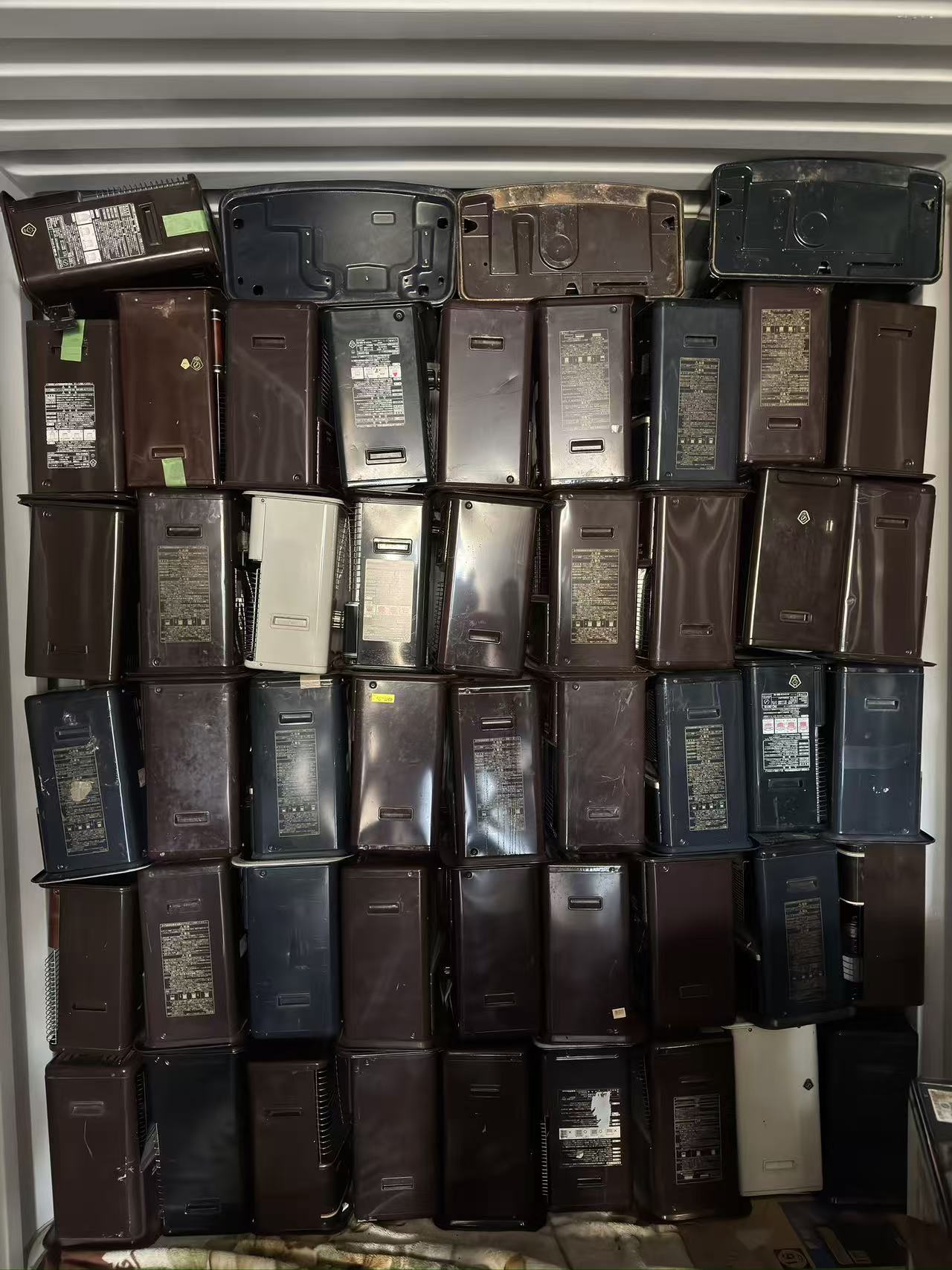
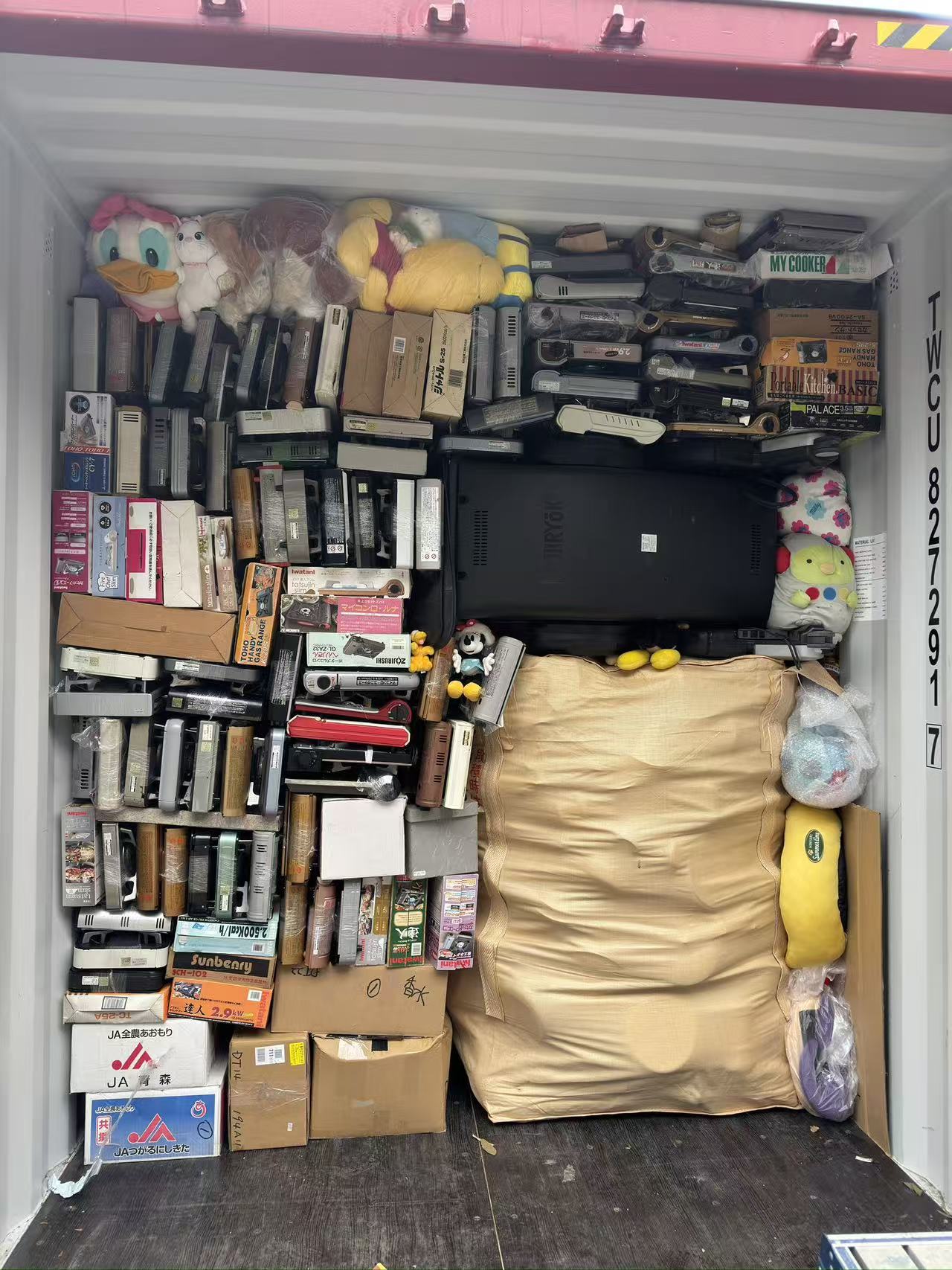
Proof: the loaded container from the documented project, photographed before sealing.
Category Check: Which Buyback Streams the Gap Applies To
Supply gaps are category-specific, because screening criteria and loading behavior differ by product. Before locking volume, match your manifest to the streams the supplier actually handles.
Household electronics buyback. Refrigerators, washing machines and microwaves form the core of the relocation-season surge. They are also the most space-hungry items, which is why nested loading and strapping discipline move utilization more than any other category.
Home entertainment electronics buyback. Game consoles and optical instruments appear in Tenma's published product scope. Entertainment stock is smaller and denser than white goods, so it usually fills the residual volume left by appliances.
Kitchen appliance buyback. Kitchenware and stainless-steel commercial kitchen equipment are within the published scope, and they behave differently from consumer appliances: mixed metal and glass components need separating and individual wrapping rather than bulk stacking.
Used household device buyback. Furniture, household sundries, bicycles and outdoor sports goods broaden a container beyond appliances and help balance weight and volume when appliance supply is tight.
Smart home device buyback. Network-connected hardware raises a data question rather than a loading question. Confirm in writing how storage media are treated before the goods are packed, and check destination requirements separately.
Music gear buyback. Guitars and basses, pianos and keyboards, studio audio equipment, professional music gear and DJ equipment are not listed in Tenma's published category scope, so treat them as a scope item to be agreed explicitly rather than assumed. Their inspection logic also differs: neck and fret condition, key action and mechanical integrity, and electronic function are separate checks from the appearance screening used on appliances. If your business depends on music gear, ask for the inspection criteria in writing before committing volume.
Narrow scope is normal in this industry rather than a red flag. Back Market's published trade-in terms, for example, limit its BuyBack service to mobile phones, game consoles, audio headsets and headphones, tablets and MacBooks as of 2023 — a deliberately narrow list from a large platform. Use published category coverage as a benchmark for what you must confirm, never as evidence of what a market can supply.
Peak-Season Supplier Checklist
The comparison below uses the criteria that decide whether a container sails on schedule. The broker column describes the channel as documented in the Cambodian case, not every broker in Japan; the JQ-SMC column lists what the licensed route provides.
| Selection criterion | Broker channel described in the documented case | Licensed JQ-SMC route |
|---|---|---|
| Physical presence in Japan | Paper trading; no in-country warehouse | 3,000 m² facility in Chiba; goods received, graded and held before loading |
| Licensing | No official Secondhand Dealer License | Official Secondhand Dealer License, National Public Safety Commission of Japan |
| Where unsellable units are removed | After arrival, at the buyer's cost | Inside Japan, by piece-by-piece appearance screening before loading |
| Container planning | Volume filling | 3D space-utilization modeling and nested loading; 18% utilization gain recorded in the documented shipment |
| Export documentation | Limited | Bilingual packing list, commercial invoice, export permit, bill of lading, loading and seal photos |
| Planning capacity | Tied to whatever clear-out lots are available | Reported export processing of 20–30 × 40ft HQ containers per month |
| Lead time | Variable | 7–14 working days for inspection and loading after deposit; 12 working days to vessel departure in the documented project |
Five checks to run before committing volume in a peak season:
- Ask for the license and confirm which entity will issue your export documents.
- Ask where scrap is removed, and require the answer to be before loading, inside Japan.
- Request raw photo or video evidence of the actual screened lot, not catalogue images.
- Confirm in writing the working-day window between deposit and container sealing.
- Confirm that destination clearance, duties and inland transport are your responsibility, and budget them.
Frequently Asked Questions
Is it legal to export secondhand consumer electronics from Japan, and who handles clearance?
Yes. Used-goods trade is regulated in Japan through the Secondhand Dealer License, and licensed operators can export. Tenma International Inc holds the license issued by the National Public Safety Commission of Japan and handles Japanese domestic export customs clearance plus vessel booking under FOB Japanese port or CFR/CIF terms. The license does not travel with the container: destination import clearance, tariffs, duties and inland transport after arrival remain the buyer's responsibility, and returns caused by a change in the destination country's legal policy fall outside scope. For data-bearing devices, ask separately how storage media are handled, using NIST SP 800-88 Revision 2 as the reference standard for media sanitization.
Can a Japanese supplier keep containers moving through relocation season?
Capacity allows it, provided the order is placed early. Tenma reports domestic collection and handling of more than 10 tons per month and export processing capability of 20–30 high-cube 40ft containers per month, with an on-time container departure objective above 95%. The binding constraint during peak season is manifest timing rather than loading speed: inspection and loading take 7–14 working days after the deposit is received, so a buyer who wants a mid-season sailing needs the manifest and deposit locked before the season peaks.
How does screening scrap inside Japan change the cost per sellable unit?
It removes two costs at once. Unsellable units never consume container volume, so freight is spread across sellable stock only — 18% better space utilization was recorded in the documented shipment — and they never trigger local disposal fees at the destination, which the Cambodian buyer had previously paid on every blind-box container. In that project the arrival rate of heavily damaged material fell from over 25% to zero for the delivered container. Separately, the JQ-SMC model targets retail margin improvement of 15%–20% versus sourcing through secondary brokers; that is a stated objective of the model, not a guaranteed outcome for any individual order.
Can I inspect the goods before the container is sealed?
Yes, remotely. Tenma supplies raw photo and video samples of the screened inventory for online confirmation, in uncleaned and unrepaired condition, and offers live-video warehouse tours and goods inspection through Zoom or Microsoft Teams in Chinese, Japanese or English. Plan for what the sample shows: appearance and structural completeness are screened, but the goods are neither cleaned nor repaired and are not sold as tested working units. If your model requires functional testing or cosmetic grading beyond appearance, agree that specification in writing before the order is confirmed.
How long does a peak-season order take, and how do I start?
Allow 7–14 working days from deposit to completed inspection and container loading, depending on category and volume, plus the customs and sailing phase. In the documented project, 12 working days covered cargo lock-in, in-warehouse screening, off-site loading, Japanese customs clearance and vessel departure. To start, send your category mix and target volume through Tenma International Inc, by email at tenma09271113@gmail.com, or via WhatsApp and LINE; the English catalogue is available for download below.
Conclusion: Close the Gap Before the Season Peaks
The relocation-season supply gap is not solved by finding more Japanese stock. It is solved by deciding what enters the container before anything is loaded: a manifest agreed early, a warehouse where scrap is blocked, a remote confirmation on raw condition, a space-planned load, and clearance under a licensed exporter. Tenma International Inc runs those five steps as the JQ-SMC model, and the documented Chiba-to-Phnom Penh shipment shows what the sequence produced under real conditions — scrap reduced from over 25% to zero for that container, 18% better space utilization, and four working days removed from the timeline.
If your next peak season depends on containers that arrive sellable rather than merely full, start with the manifest rather than the sailing date.
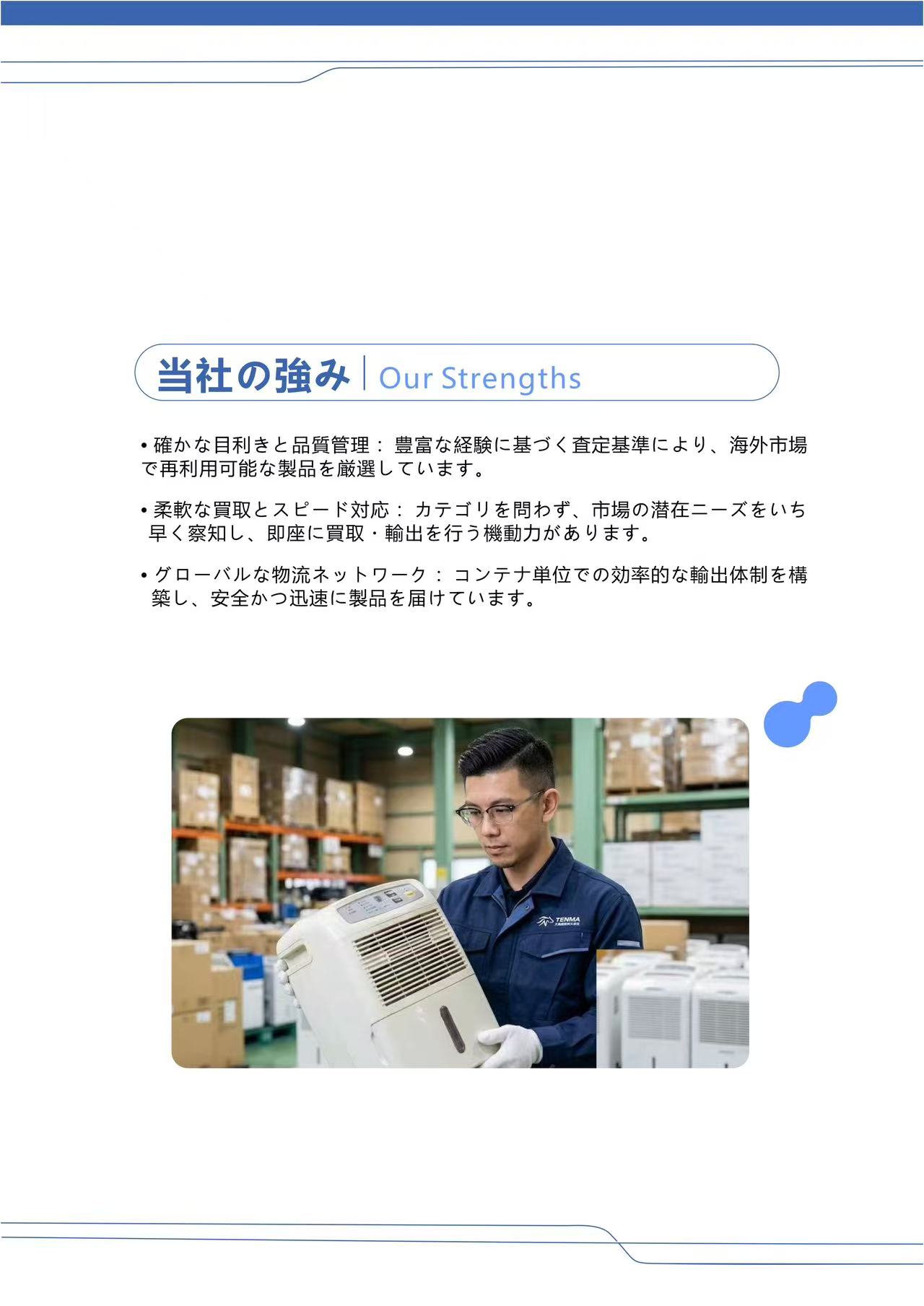
Next step: download the English catalogue, then confirm category scope, volume and lead time for your season.
Have Questions or Need More Details?
Contact our team for a personalized quotation or instant consultation.
Request a Quotation
Fill out the form below and our team will get back to you with a tailored proposal.
WhatsApp Direct Chat
Prefer to chat in real-time? Message us on WhatsApp for instant assistance & quick answers.
- Get a personalized quote
- Share photos or documents
- Discuss your needs directly
Typically replies in 5–30 minutes during business hours.