
Consumer Electronics Buyback: 25% Junk Arrivals vs JQ-SMC
Consumer Electronics Buyback: Fixing 25% Arrival Junk — Comparing Common Remedies with the JQ-SMC Model
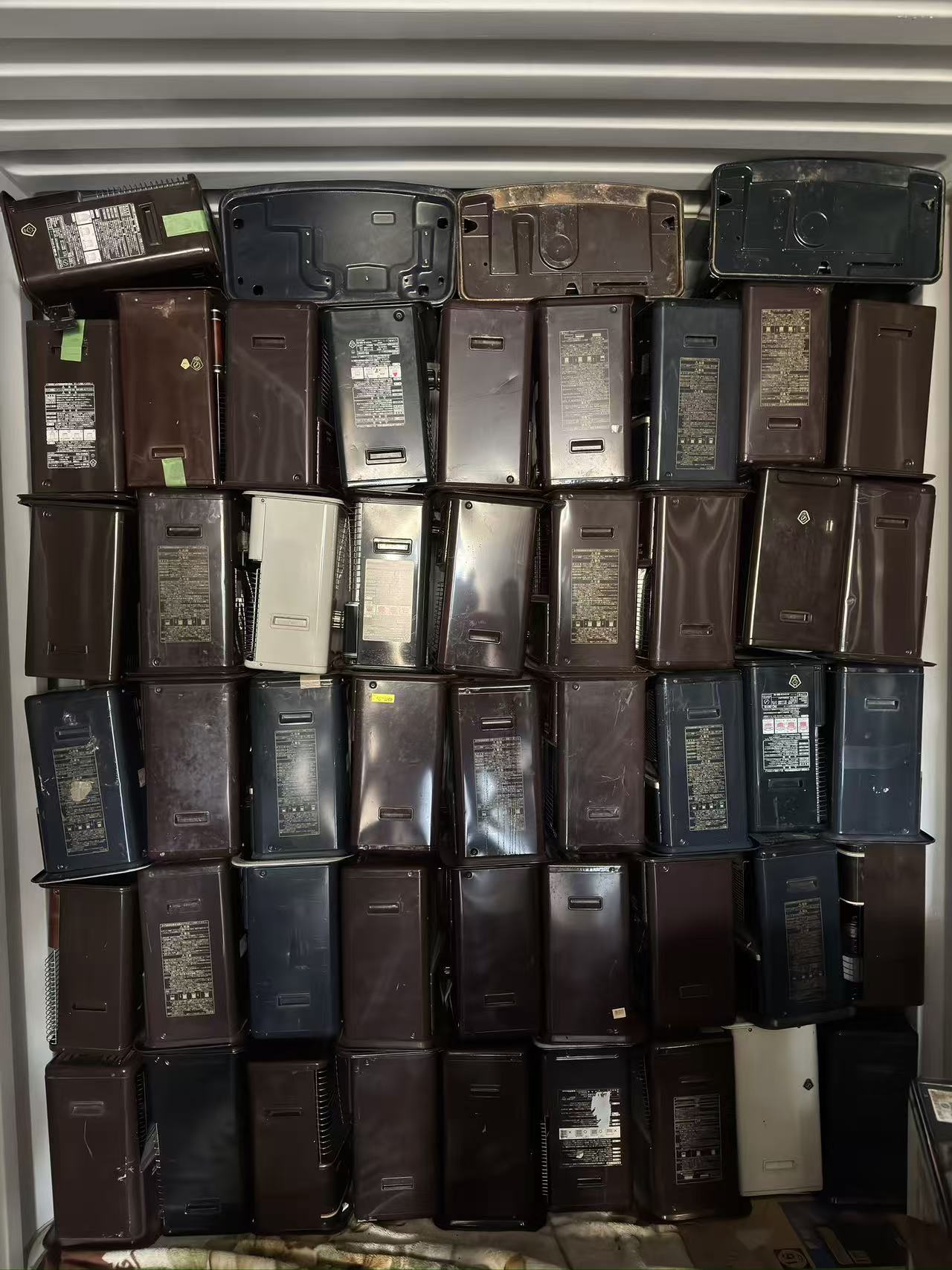
A sealed export container of screened Japanese used goods. In the JQ-SMC model the screening decision is already finished before this door closes.
A 25% arrival junk rate in a consumer electronics buyback container is not a shipping accident and not bad luck at the destination port. It is the predictable output of three decisions made weeks earlier: where the goods were bought, whether any single person inspected them before the container doors closed, and whether the export file was complete enough to leave Japan without rework.
Tenma International Inc is a Japan-based trading company founded in 2023 that operates as an asset-holding recycler holding an official Japanese Secondhand Dealer License. Under its standardized model, the company reports an arrival scrap rate reduced from a 20% baseline to 1%. In a documented Cambodian container project, heavily damaged or unsellable arrivals fell from over 25% to exactly 0%.
This comparison guide is written for overseas B2B importers in the evaluation-to-execution stage of a buyback program. It diagnoses what the 25% figure actually measures, compares four common remedies — broker paper-trading, one-off Yahoo Auctions sourcing, unsorted clearance lots, and the JQ-SMC standardized procurement model — and shows which mechanisms, rather than which promises, change the arrival outcome.
Problem Definition: What a 25% Arrival Junk Rate Really Measures
Arrival junk is the share of a container's contents that cannot be sold, cannot be profitably recycled, or must be disposed of at destination at the importer's cost. It is measured after devanning, which is why buyers only discover it at the moment the freight bill is already sunk.
The failure is not only the lost resale value of the junk itself. It carries four compounding costs: ocean freight paid on unsellable mass, local waste-disposal fees at the destination, warehouse labour spent sorting unusable items out of sellable stock, and market reputation damage when wholesale customers open a box and find crushed plastic or bent metal frames.
In the documented Cambodian case, the buyer had purchased "blind-box" containers through generic, unlicensed Japanese brokers. To fill volume, those channels stuffed containers with heavily damaged, dismantled, or entirely unusable local scrap. The buyer paid international ocean freight on material that had no resale path, and then paid again to dispose of it in Phnom Penh.
Four failure points that produce junk arrivals
| Failure point | What goes wrong | Where it surfaces |
|---|---|---|
| Sourcing layer | Goods are described from a price list or a phone call, not from a physical yard holding the stock | Quotation stage |
| Screening layer | No single item is graded before loading, so broken units enter the load as volume filler | Loading day |
| Loading layer | Poor stacking leaves volumetric gaps and collision damage in transit | Arrival inventory count |
| Documentation layer | Incomplete or inconsistent export paperwork delays departure and blurs responsibility for what was shipped | Japanese customs |
Industry Background: Why Buyback Containers Still Arrive Dirty in 2026
The demand side of buyback is large and growing. Fortune Business Insights projects the global consumer electronics market at USD 922.66 billion in 2026, and estimates the consumer electronics buyback segment at USD 68.24 billion in the same year. Both figures come from commercial research and should be read as directional market sizing rather than audited statistics.
The supply side is where the quality problem lives. Mainstream platform buyback programs remain narrow in category scope. Back Market's published BuyBack terms list mobile phones, game consoles, audio headsets and headphones, tablets, and — since 2023 — MacBooks. Household appliances, home entertainment systems, smart home devices, kitchen appliances, and professional music gear sit largely outside those platform scopes. That is precisely why B2B importers of these categories depend on wholesale channels, where screening discipline varies enormously from one supplier to the next.
Japan adds a regulatory layer that most destination buyers never audit. Dealing in secondhand goods in Japan requires a Secondhand Dealer License issued under the National Public Safety Commission framework, held at corporate level by licensed operators. A counterparty that cannot show that license is not necessarily acting unlawfully in every transaction, but it has no licensed intake, no traceable inventory ledger, and no standing to declare exports in its own name.
The honest gap: there is no verified public dataset that isolates arrival-condition quality by supplier type. Claims about junk rates circulate as buyer anecdotes. What can be verified is the outcome of a specific documented project, which is the basis used throughout this guide.
The Fix That Changes the Mechanism: How the JQ-SMC Model Works
JQ-SMC stands for Japanese Quality-Driven Source Management and Cross-Border Supply Chain Model (V3.0). It is not a grading promise. It is a relocation of the inspection decision from the destination warehouse to the Japanese warehouse, executed by the party that already owns the goods.
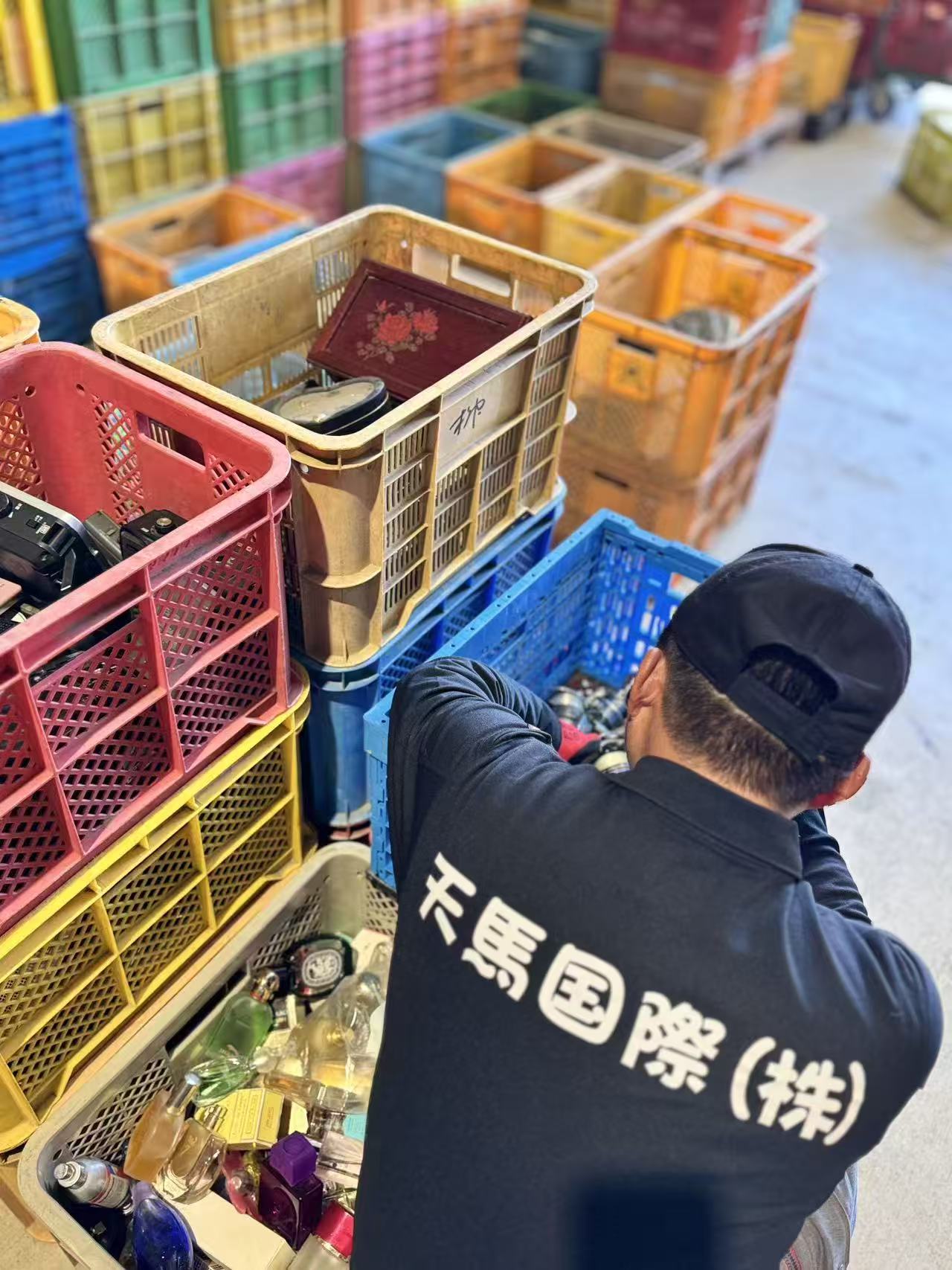
Piece-by-piece physical appearance screening inside the Chiba facility. Sub-standard lots are intercepted here, not at the destination port.
Layer 1 — Native Japanese sourcing with physical custody
Tenma International Inc sources directly within Chiba Prefecture and the surrounding Kanto region, using a local recovery network built over 3+ years in Japanese secondhand goods recycling and international circular economy trade. Because the company operates modernized storage warehouses and large-scale sorting facilities in Chiba and other prefectures, the goods exist physically before they are sold. That single structural difference is what separates this model from paper-trading: there is a yard, a ledger, and an inspection point.
Layer 2 — Piece-by-piece warehouse condition screening
On warehouse receipt, staff inspect each item's initial physical appearance, completeness, and wear-and-tear level, and assign an aesthetic grade. Shattered, loose, dismantled, or heavily decayed items are blocked inside Japan. This is the mechanical step that converts a 25% arrival junk rate into a 0% rate: the junk never boards the vessel, so no freight is ever paid on it.
The screening is supported by a structured capability base: an intelligent multi-category recycling valuation and pricing system, a digital inventory management and sorting system, and 3D digital container space utilization modeling. Four departments carry the workflow — Domestic Japanese Sourcing, Warehouse QC and Refurbishment, International Key Account Trade, and Logistics and Export Compliance — with named roles for a Senior Secondhand Asset Valuer, a Professional QC Inspector, a Container Loading Strategist, and an International Logistics Manager.
Layer 3 — Compliant Japanese export declaration
Shipments are declared to Japanese customs using the corporate Secondhand Dealer License and registered Japanese corporate legal entity qualification. Each container is released with a bilingual packing list, a commercial invoice, high-definition loading photographs showing the seal number, and a Japanese customs export permit, followed by the bill of lading or telex release. Documentation is not admin overhead: it is the record that lets a buyer verify, item by item, that what was declared is what was loaded.
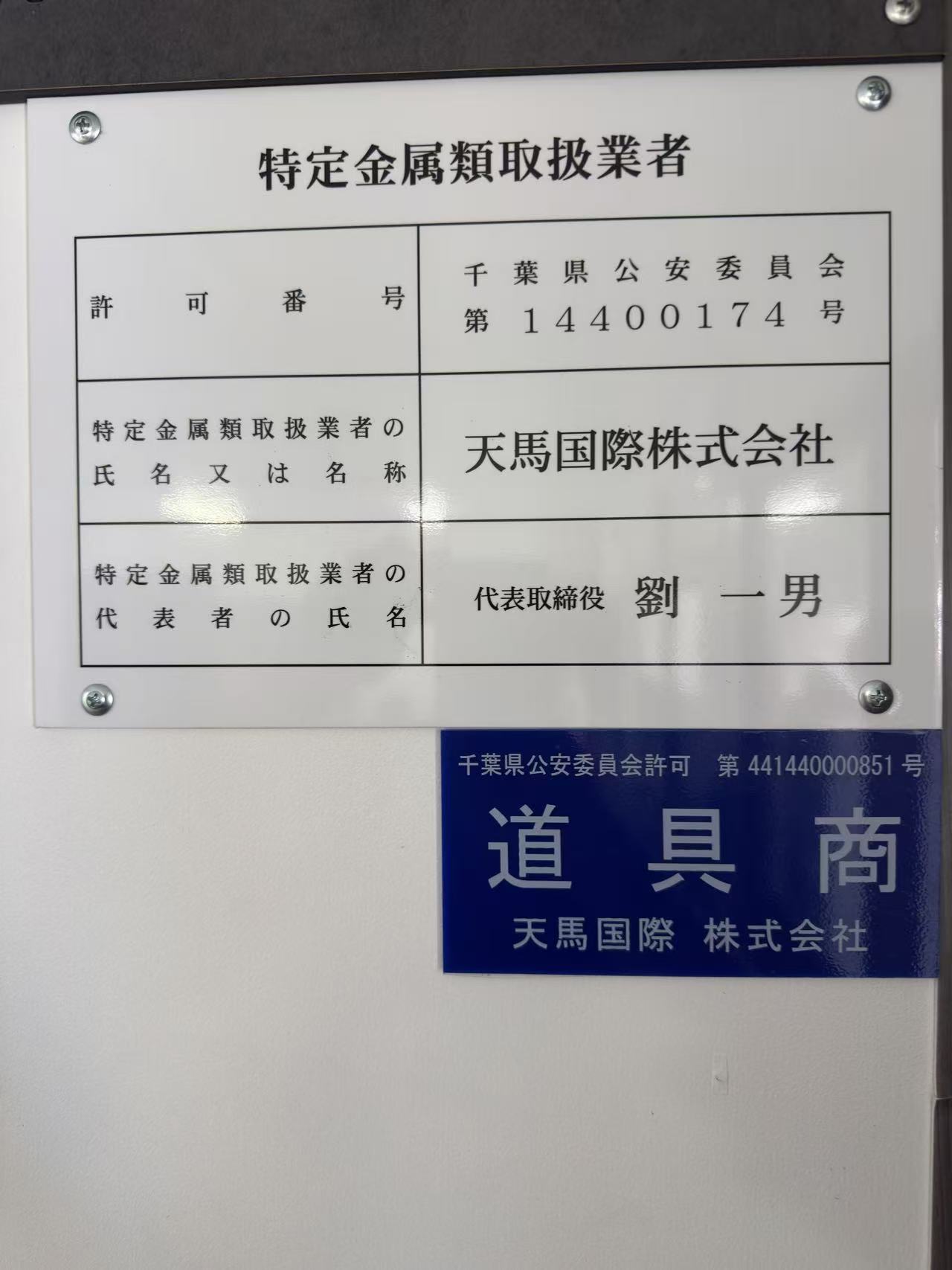
Licensing and permit documentation supports each export declaration. Buyers should ask to see it before the deposit leaves their account.
Explicit scope boundaries — what this model does not do
The JQ-SMC process excludes secondary cleaning, electrical or functional testing, and repairs. Goods are exported in their raw, collected condition on a "what you see is what you get" basis. Buyers receive authentic photo and video samples showing unretouched product condition before loading.
This boundary is a feature for wholesale buyers who resell on appearance and completeness, and a constraint for buyers who need functional guarantees. Any supplier promising "guaranteed working or fully washed" goods at wholesale container pricing is describing a process that does not exist in this channel. Buyers handling data-bearing devices must also plan their own sanitization program; recognized frameworks such as NIST SP 800-88 Revision 2 (2025) describe media sanitization practice, and that obligation sits with the party that will resell the device, not with an appearance-grading warehouse.
Step-by-Step Breakdown: From Manifest to Sealed Container
| Stage | What happens | Output you receive |
|---|---|---|
| 1. Demand alignment and native sourcing | Category mix, grade expectation and container type are defined, then premium sourcing is triggered across Chiba and surrounding areas | Bulk purchase contract and estimated export schedule |
| 2. Warehouse receipt and condition screening | Every item is inspected for appearance, completeness and wear, then graded; sub-standard lots are intercepted | Screening manifest plus raw photo and video records of actual condition |
| 3. Off-site container loading and securing | Passed items are loaded with space-optimized, collision-prevention layouts and anti-shock reinforcement | Bilingual packing list, commercial invoice, HD loading and seal-number photos |
| 4. Japanese customs and ocean dispatch | Export is declared transparently under Secondhand Dealer credentials and the vessel is booked | Customs release note, bill of lading or telex release, export permit |
Timeline and the revision window
Stages 1 and 2 typically run 7 to 14 working days after deposit, depending on volume and how mixed the category mix is. Stages 3 and 4 add 3 to 5 working days once shipping space is confirmed. In the documented Cambodian project, the full cycle from cargo lock-in through screening, heavy loading, customs clearance and vessel departure took 12 working days — 4 working days faster than the buyer's previous broker-based cycles.
One operational detail matters commercially: modifications are accepted until the container is physically sealed. A buyer can scale down bicycles, expand appliances, or shift grade proportions while goods are still in the warehouse, and sourcing is re-pivoted with the packing list adjusted. Once the seal is applied, the manifest is locked. For importers testing a new category before committing to a full container program, that window is the cheapest risk control available.
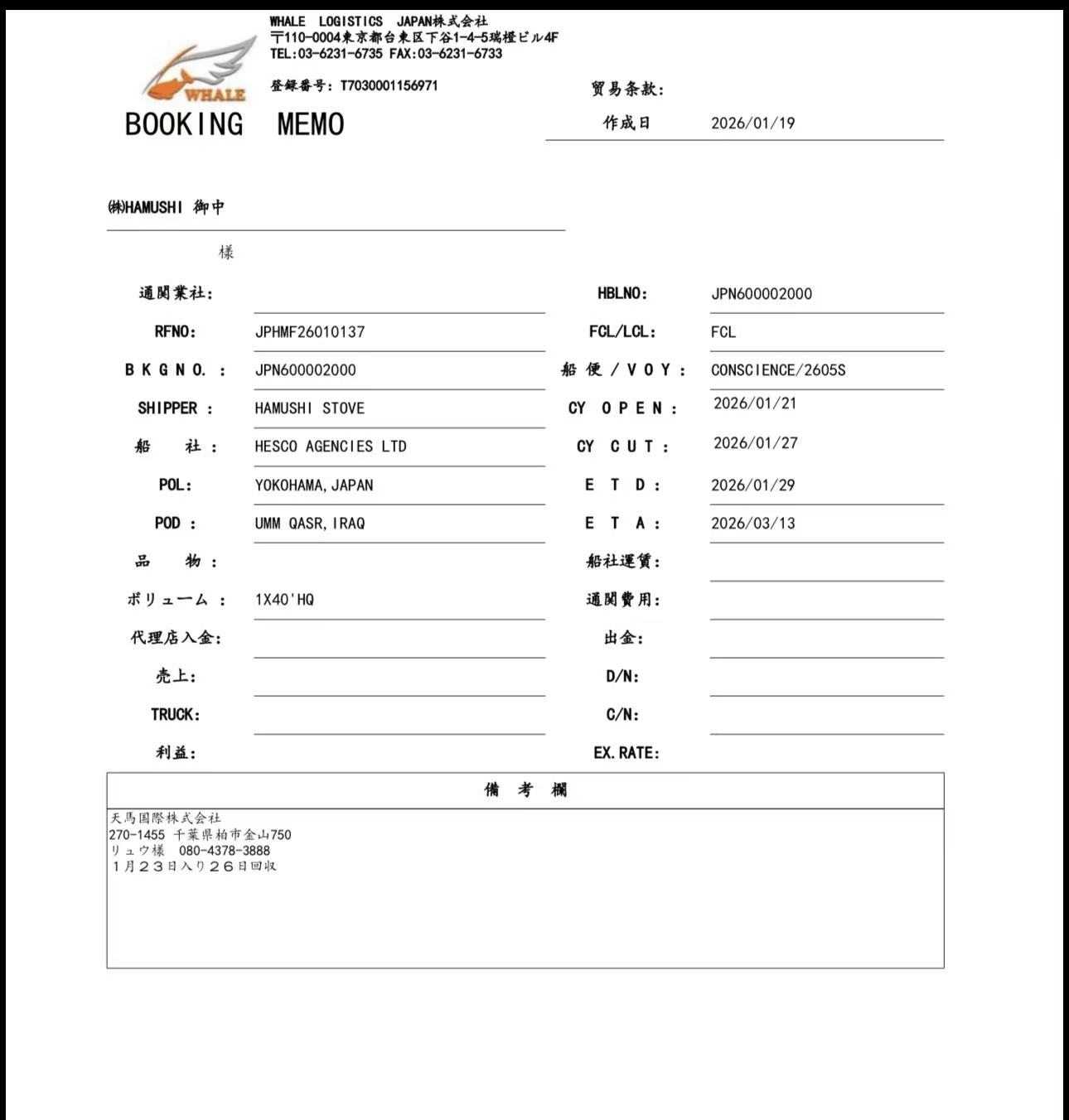
Freight booking memo for a scheduled departure. Departure timing is a documentation outcome as much as a logistics one.
Use Cases: Where the Model Fits and Where It Does Not
Household and kitchen appliance importers. Bulk buyers supplying flea market chains and wholesale warehouses in Southeast Asia use screened mixed loads of refrigerators, washing machines, microwaves and stainless kitchen ware. These categories are bulky, freight-heavy, and therefore the most expensive place to absorb junk: every unusable unit consumes cubic metres that were paid for by sea.
Home entertainment and smart home mixed loads. Audio units, game consoles, optical instruments and small connected devices can be nested into the gaps left by large appliances. Three-dimensional container space modeling raises effective utilization — the documented project recorded an 18% increase — which lowers the amortized freight cost per sellable item rather than per cubic metre.
Flea market and wholesale chain operators. The Cambodian buyer in the reference case operates several wholesale warehouses and flea markets around Phnom Penh. For this profile, predictable baseline condition matters more than cosmetic perfection, because a container that arrives clean protects both resale margin and customer trust.
Professional music gear and instrument sourcing. Guitar and bass, piano and keyboard, studio audio and DJ equipment sit in a different risk class: unit values are higher, condition assessment is more specialized, and public third-party data on resale margins in this segment is thin and largely secondary in nature. Tenma International Inc's documented buyback scope centers on second-hand home appliances, furniture and sundries, optical instruments and game consoles, with commercial kitchen and office equipment and outdoor sports goods also served. Buyers expanding into professional music gear should validate grading on a physical sample lot first, and should not assume that an appliance-grade screening standard transfers unchanged to instruments.
Where the model is a poor fit. Buyers who require functional testing, warranty coverage, refurbished-and-boxed stock, or per-unit retail-grade grading should not use a raw wholesale container channel at all. The cost structure that makes container pricing attractive is built on the absence of those services.
Comparison Table: Four Remedies, One Set of Criteria
| Remedy | Where goods come from | Screening point | Arrival junk exposure | Documentation received |
|---|---|---|---|---|
| Broker paper-trading | Intermediated offers; no yard holding the stock | None before sealing | High — volume is filled with whatever is cheapest to load | Invoice and packing list from the intermediary |
| One-off Yahoo Auctions sourcing | Individual listings won lot by lot | Per-listing only; no consolidated grading step | Variable — condition truth depends on the individual seller | Auction records; export file assembled separately |
| Unsorted clearance lots | Bulk clear-outs loaded as collected | None | Highest — mixed scrap and dismantled units travel at full freight | Minimal |
| JQ-SMC model (Tenma International Inc) | Native sourcing in Chiba and the Kanto region, held in own warehouses | Piece-by-piece appearance, completeness and wear grading inside the Japan warehouse | Measured: over 25% down to 0% in the reference project; scrap rate 20% baseline down to 1% | Bilingual packing list, commercial invoice, HD loading and seal photos, Japanese customs export permit, B/L |
Rows 1 to 3 describe the structural pattern documented in the reference buyer's earlier purchasing, not a verified audit of every provider operating in those channels. All quantitative figures in the final row come from the documented container project and the supplier's reported scrap-rate outcome.
FAQ
Does the JQ-SMC model include compliant export documentation from Japan?
Yes. Tenma International Inc holds an official Secondhand Dealer License issued by the National Public Safety Commission of Japan, together with Japanese corporate legal entity qualification. Each container is declared to Japanese customs under those credentials and released with a bilingual packing list, a commercial invoice, high-definition loading photographs showing the seal number, and a Japanese customs export permit, followed by the bill of lading or telex release confirmation. Import clearance, tariffs and inland logistics at the destination remain the buyer's responsibility.
What quality-control capability actually stops junk from arriving?
A physical inspection point located before loading. In this model, goods are centralized in the Chiba warehouse, where staff inspect each item's initial physical appearance, completeness and wear-and-tear level and assign an aesthetic grade; sub-standard lots are intercepted inside Japan. The capability is organizational as much as technical: four departments — Domestic Japanese Sourcing, Warehouse QC and Refurbishment, International Key Account Trade, and Logistics and Export Compliance — supported by a digital inventory management and sorting system and 3D container space utilization modeling. Note the scope limit: screening is appearance-based, with no secondary cleaning, no electrical or functional testing and no repairs.
What drives the cost of a buyback container — unit price or freight efficiency?
In bulk secondhand containers, freight efficiency often decides margin more than unit price does, because every cubic metre is paid for whether or not the item inside it is sellable. Two levers control this: eliminating junk before loading, and raising effective space utilization through nested, anti-shock loading layouts. In the documented Cambodian project, effective container space utilization increased by 18%, which reduced per-item amortized ocean freight, and the elimination of junk removed destination waste-disposal fees entirely. Tenma International Inc does not publish container pricing; quotations depend on category mix, grade proportions and volume, which is why the sealed-container revision window matters commercially.
Can a buyer validate actual condition before the container is sealed?
Yes, and this is the intended control point. After screening, the supplier provides raw photo and video samples of the screened inventory — uncleaned, unrepaired, showing authentic product condition — for online confirmation before loading. Remote live-video inspection and warehouse tours are supported through LINE, WhatsApp, WeChat, Email and Zoom or Microsoft Teams, and progress reports are synchronized weekly during sourcing and screening. On loading day, live photo and video streams of key milestones are shared, and the seal-number photographs accompany the final packing list.
What lead time should an importer plan for?
Plan 7 to 14 working days after deposit for sourcing and condition screening, plus 3 to 5 working days for loading and customs dispatch once shipping space is confirmed. The reference project completed the full cycle — cargo lock-in, in-warehouse screening, off-site heavy loading, Japanese customs clearance and vessel departure — in 12 working days, 4 working days faster than the buyer's prior broker-based cycles. Monthly export processing capacity is 20 to 30 40ft high-cube containers, with domestic collection handling above 10 tons per month in Japan. To test the fit on your own category mix before committing a full container, request a sample confirmation pack and a quotation at tenma-corp.com or via WhatsApp at +81 80 4378 3888.
Conclusion
Arrival junk is a sourcing-architecture problem, not a shipping problem. Brokers, one-off auction wins and unsorted clearance lots all share the same defect: the inspection decision happens after the freight is committed, or never happens at all. The JQ-SMC model moves that decision into a Japanese warehouse, where the goods already sit in physical custody and where a licensed operator can intercept a bad lot before it becomes an expensive cubic metre at sea.
The evidence is narrow but specific: heavily damaged or unsellable arrivals reduced from over 25% to 0% in a documented Cambodian container project, a reported scrap rate of 1% against a 20% baseline, an 18% gain in effective space utilization, and 4 working days removed from the delivery cycle. Equally specific are the limits — raw, uncleaned, untested goods on a what-you-see-is-what-you-get basis, with no functional guarantee and destination clearance owned by the buyer.
For importers in the evaluation-to-execution stage, the practical next step is not a price list request. It is a request for the screening manifest, the photo and video condition record, and the documentation set from a completed container — then a single sample lot to test whether the grading standard matches your market.
Next step: verify the process on one container
Tenma International Inc — Japan-based asset-holding recycler, founded 2023, Secondhand Dealer License holder. English, Chinese and Japanese communication. Export destinations include Thailand, Cambodia and other Southeast Asian markets as well as global regions.
Email: tenma09271113@gmail.com | WhatsApp: +81 80 4378 3888 | LINE: @tenma09271113
Address: 750 Kanayama, Kashiwa-shi, Chiba, 270-1455, Japan
Download the product and service catalogue: Tenma International English Catalogue (PDF)
Have Questions or Need More Details?
Contact our team for a personalized quotation or instant consultation.
Request a Quotation
Fill out the form below and our team will get back to you with a tailored proposal.
WhatsApp Direct Chat
Prefer to chat in real-time? Message us on WhatsApp for instant assistance & quick answers.
- Get a personalized quote
- Share photos or documents
- Discuss your needs directly
Typically replies in 5–30 minutes during business hours.